.txt
.exe
Logic.sys
Tales.pub
Sydney Granat
Principal Product Designer & Systems Architect
Executing commands to build unified ecosystems, collaborative B2B environments, and enterprise SaaS architecture. Double-click or tap the icons to launch files. Check the start menu for fun!
GovCon360: Architecting B2B Identity and Billing
Untangling complex data architecture, user permissions, and hybrid monetization structures for federal government contractors.
1. The Context & Business Challenge
Phase 1 successfully established the public-facing presence. As we transitioned into Phase 2, the mandate shifted toward building the authenticated platform's core engine. The most complex friction point was untangling the data architecture for user roles and the monetization structure.
The Architectural Dilemma
The system needed to seamlessly support both B2B organizational structures and B2C individual operations. I had to define the system's foundational entity relationships: Should the platform utilize a modern, seat-based SaaS model (where individuals within a company can hold different tier access), or default to the traditional government contracting standard of a flat, company-wide access tier?
2. The Principal Decision Framework
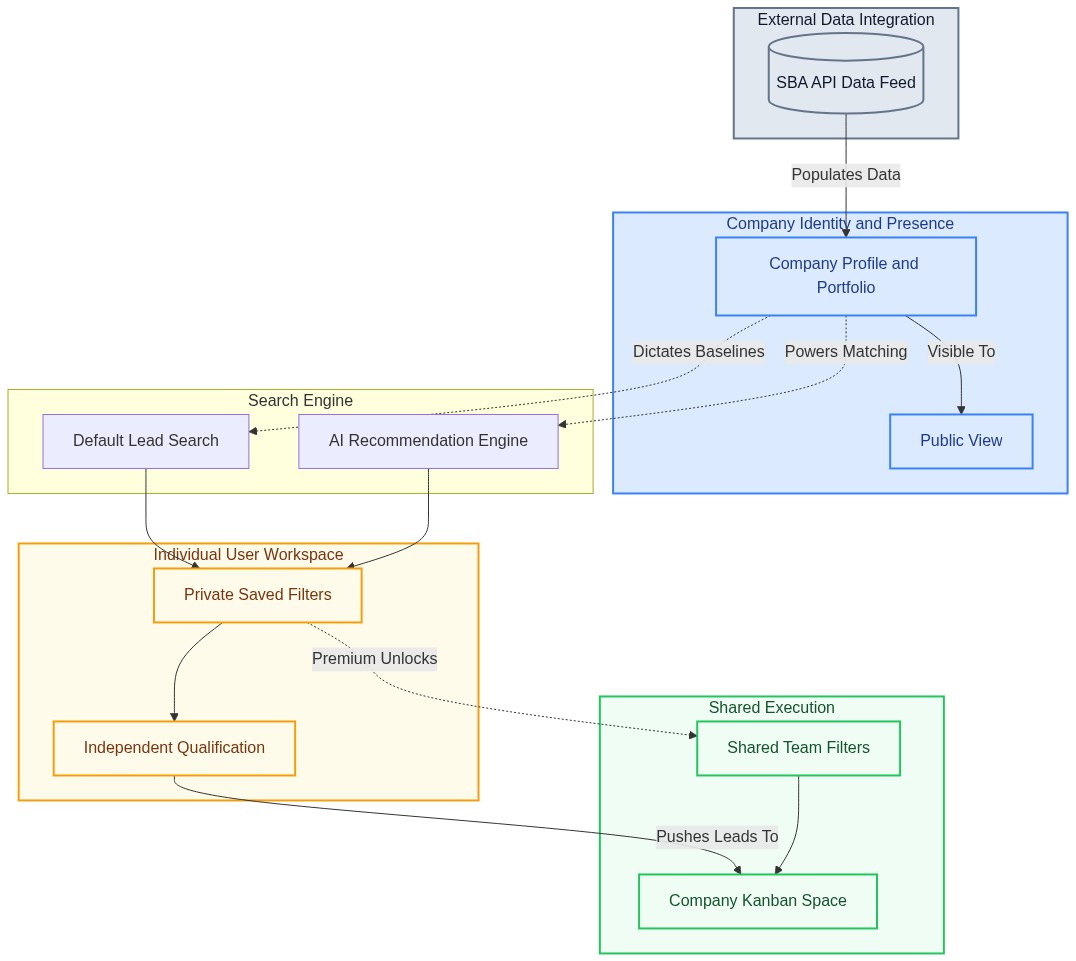
This logic map defines the data lifecycle from the external SBA integration, into the public identity layer, down to individual user workflows, and finally scaling into the shared collaborative space.
Behavior-Driven Architecture: The Pivot
Analyzing actual user behavior revealed a critical difference: GovCon360 users perform heavy independent research that eventually merges into an equal-weight collaborative environment (as mapped in the ERD above). Unlike design tools where roles are stratified between Creators and Viewers, fractured tiers within a GovCon company would instantly break collaborative workflows.
The Hybrid Solution
I pivoted the architecture to a hybrid model: Pricing is calculated per user, but the entire company is locked into a single, unified access tier. This eliminated the cognitive load of selecting different access levels for different employees while maintaining accessible costs for small businesses.
3. Architectural Outcomes & Current Focus
Unblocking the Interface Design: Solving the "Tier vs. Seat" dilemma was the prerequisite for the entire interface architecture. By decoupling Platform Roles (Admin vs. Standard User) from billing status, I successfully designed the complex Admin Dashboard. This unlocked edge cases like swapping users out of an existing seat, upgrading plans, and abstracting mid-cycle prorated billing into a frictionless checkout flow.
Nirvana Logic Suite: Architecting a Multi-Product Ecosystem
Establishing a global design language across three distinct SaaS platforms (AgentOS, Intellect, Shield) without bottlenecking live engineering.
1. The Context & Business Challenge
Nirvana Logic needed to establish a distinct, memorable brand presence that intentionally broke away from the sterile, conventional aesthetics of legacy Big Tech platforms. However, the portfolio consisted of distinct SaaS applications (AgentOS, Intellect, and Shield), each serving entirely different user personas and requiring its own unique voice.
The Architectural Constraint
The decision to unify the ecosystem occurred while these products were at vastly different stages of asynchronous development. My mandate was to architect a centralized design foundation that allowed each product to maintain its individual identity, without halting ongoing engineering momentum.
2. Strategy & Execution
Phase 1: Establishing the Public Perimeter
Before untangling the complex SaaS portals, we anchored the ecosystem by defining the core visual primitives: structural fonts, distinct gradient palettes, and a cohesive logo architecture. Rolling these out to the public-facing websites and social channels first ensured the suite felt like an established, connected family to the market.
Phase 2: The AgentOS Vanguard
Moving into the authenticated portals required establishing a scalable component library. Because the products were in varying stages of development, we used AgentOS as our guiding product. Because it was being rapidly built from the ground up using AI, it served as the perfect, high-velocity testing ground for our UX patterns.
Phase 3: Abstracting the AI-to-System Pipeline
Rather than building a theoretical design system in a vacuum, I took the live, AI-generated components functioning within AgentOS and refactored them. We systematically stripped away the product-specific UI, reshaping them into generalized, theme-agnostic foundational components. This created a scalable, master blueprint that Nirvana Intellect and Nirvana Shield could inherit seamlessly.
E-Commerce & Digital Publishing
End-to-end architecture for maverickstales.com. Configured Dublin Core metadata, e-commerce product silos, and Schema.org JSON-LD structured data to support early reading development books and manage the digital storefront.